Joy and Changing the Narrative: The Surprising Example of Sports Diplomacy Storytelling Within FIFA 2026’s Group of Death
The opportunity to reset global narratives, informed by lessons from the women’s game
Joy erupted amongst the Iraqi men’s national team and their fans at Monterrey Stadium late Tuesday night as they beat Bolivia, 2-1, to secure their berth at FIFA World Cup 2026.
“We’ve made 46 million people happy,” the Lions of Mesopotamia's [Australian] head coach Graham Arnold said of the win.
Iraq will now play France, Senegal, and Norway in the tournament’s so-called Group of Death this June. And they’ll do so in one of North America’s biggest media markets: the Northeast, with games scheduled in Boston, Philadelphia, and New York/New Jersey.
That represents an unparalleled sports diplomacy storytelling opportunity.
For even though players on national teams engage in a type of formal sports diplomacy on behalf of their country, they are often more authentic representatives from and of the people than the elites. At a World Cup, elite athletes have a heavily mediatized global platform through which to represent, communicate, and negotiate foreign public opinions and understandings about their homeland, its people, and its football culture.
That’s why national teams at a major tournament are unique storytellers, and Iraq’s women’s team can provide lessons for how their male counterparts can help reset global narratives about the country this summer.
One of the stories that undoubtedly will be told is that of resilience and return. Iraq’s last World Cup appearance was at FIFA Mexico 1986. Back then, the Iraqi team played the hosts, Paraguay, and Belgium in Group B. They compiled a winless record on-pitch but etched their story into the history books at a time when the country was enmeshed in a deadly war with Iran.
Exposure on the world’s biggest football stage was an experience that longtime national team defender, Adnan Dirjal, missed out on. The former skipper, who garnered 100+ caps between 1979 and 1990, was injured just before that summer’s campaign and thus unable to play.
A return to the World Cup has driven his efforts as president of the Iraqi Football Association (IFA). Elected in 2021, Dirjal brought the IFA in line with FIFA’s governance standards and has worked to address the mandate laid out by FIFA”s Women’s Football Strategy to develop and grow the women’s game.
The IFA’s key partner in this effort?
The French Football Federation (FFF).
A story of resilience and return isn’t the most obvious one connecting the two federations, particularly as France sit atop FIFA’s men’s world ranking while Iraq is #57.
Many forget that France was an inconsistent men’s World Cup attendee in the last half of the twentieth century. After a third-place finish at the 1958 edition, they failed to qualify in 1962, 1970, and 1974. Although the country was mired in a larger sports crisis after 1960 – the inability of most of its elite athletes and national teams to do well at major international tournaments – by 1972, early solutions were at hand.
That year, the FFF created the National Football Institute (INF) to develop top aspiring talent from a younger age. The following year, the first professional football clubs launched youth academies, and by the late 1970s, the FFF required all top division sides to have one.
Results began to materialize and trickled up to the national team. The iconic generation that included Michel Platini, Jean Tigana, and Alain Giresse returned Les Bleus to the world stage for FIFA Argentina 1978, took fourth place at Spain 1982, and battled for third place at Mexico 1986. Winners of the 1984 UEFA Euro title, a separate French squad took the 1984 Olympic gold medal.
After France failed to qualify for World Cup in 1990 and 1994, football officials redoubled efforts and fine-tuned their whole-of-system approach, as chronicled in The Making of Les Bleus: Sport in France, 1958-2010.
The results speak for themselves. Since 1998, when France hosted the World Cup, Les Bleus have contested the final match four times, winning the trophy twice (1998, 2018). No other country boasts that track record in the twenty-first century.
France thus created a brand identity as a country that turns out some of the world’s best players, men and women. The French national team, Les Bleues, is presently ranked #6 in the world and, with the exception of December 2024-June 2025, is a perennial FIFA top 10 team for the last 15 years (even as podium finishes remain allusive); Iraq are #166.
That’s why, since 2022, the FFF has partnered with the IFA on a women’s football diplomacy initiative to train up the Lionesses of Mesopotamia and the Iraqi women’s football ecosystem. After a few short years, those efforts already illustrate how sports diplomacy can help reshape narratives and spark joy.
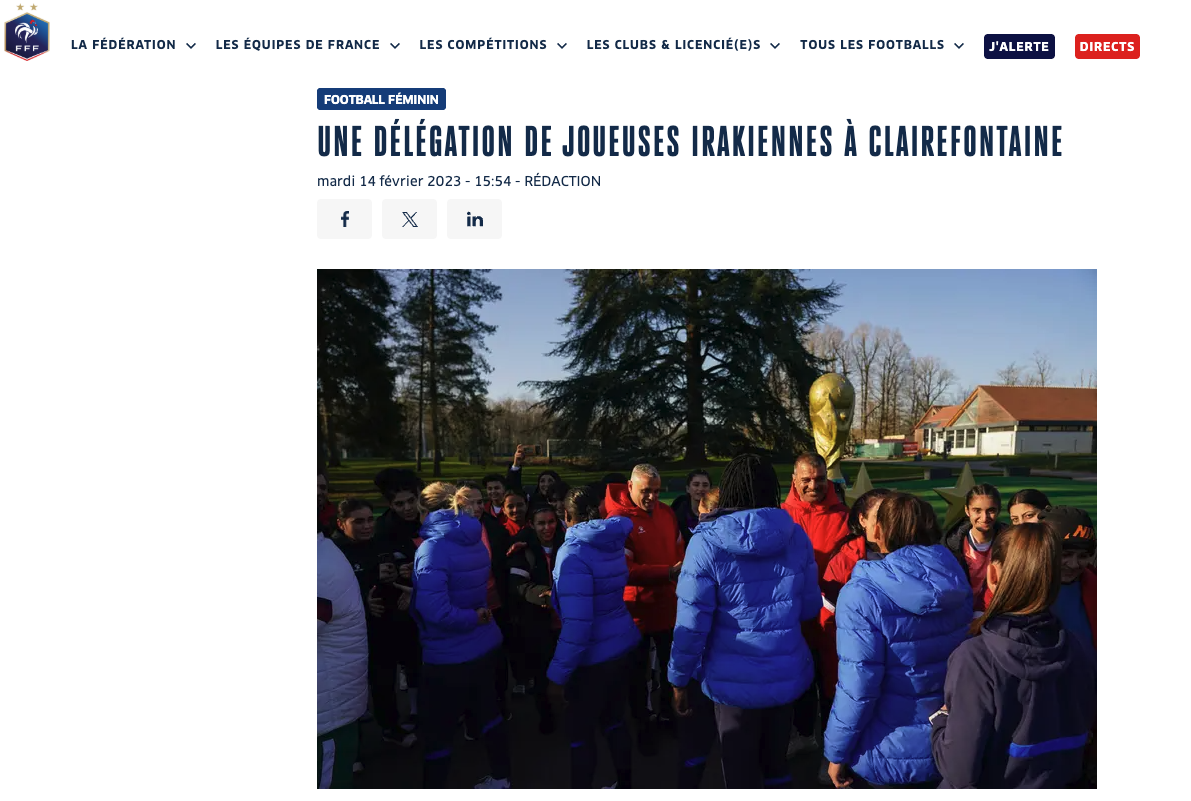
Take the team’s arrival in Paris during Winter 2024 for a one week residency and training camp at the INF in Clairefontaine. Their bright red travel uniforms caught the attention of French visa officers at Charles de Gaulle airport, who asked where the group was headed. The delegation’s translator, Yahya Alkhiro, explained their mission, which impressed officials.
“They were amazed that a country like us has a women’s football team, because the image of Iraq in international media is just about bombs and jihadists,” Alkhiro told me a week later. “‘That officer changed his mind about us as a country.”
The team was able to help shift the narrative about Iraq to outsiders, as well as shift narratives about women’s football in Iraq and female footballers.
This was highlighted by longtime women’s coach Thaer Kadhim Alarass, who served as the delegation’s chef de mission.
“When [the team] stays here at Clairefontaine with the famous [French] federation, something really grows in the mentality [of the players].”
“After the [FFF] project, really, everything has changed in women’s football,” he shared after bringing the third delegation to France.
That close association with the excellence in global football that the FFF and its training center represent shifted how the Iraqi team thought of themselves. “Every girl in Iraq wants to be playing football,” Alarass said. “This is the impact of this project because they saw all the players go to this center.”
It also rewrote their story. No longer siloed off, because now they were part of the larger work of growing and investing in the women’s game, part of a global effort. And it helped to provide a new narrative for the Lionesses of Mesopotamia, one centered around their football cultural identity.
“They are proud because they are [at Clairefontaine] and are attached with French football culture,” Alarass said. “This is our ID in football form.”
The Iraqi women’s national team’s football diplomacy with the French illustrates how traveling and playing on an international stage can help shift narratives, of how a team can communicate, represent, and negotiate understandings of a country, its people, and its football abroad and at home.
Imagine what their male counterparts might be able to do this summer on the FIFA World Cup stage.
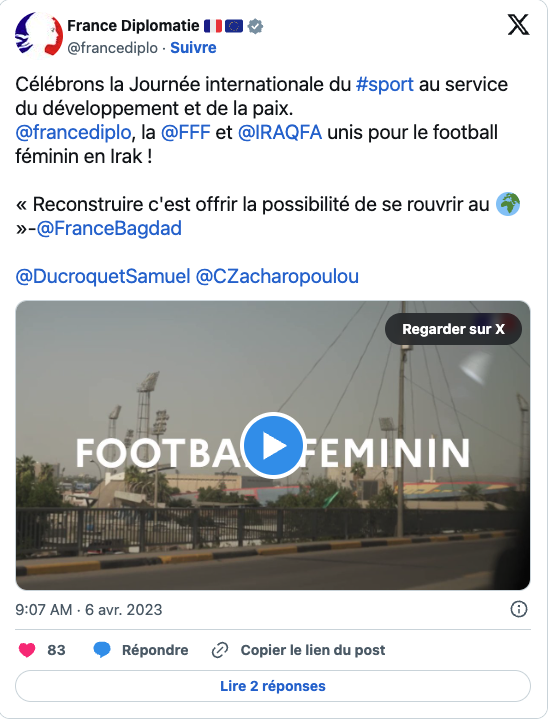
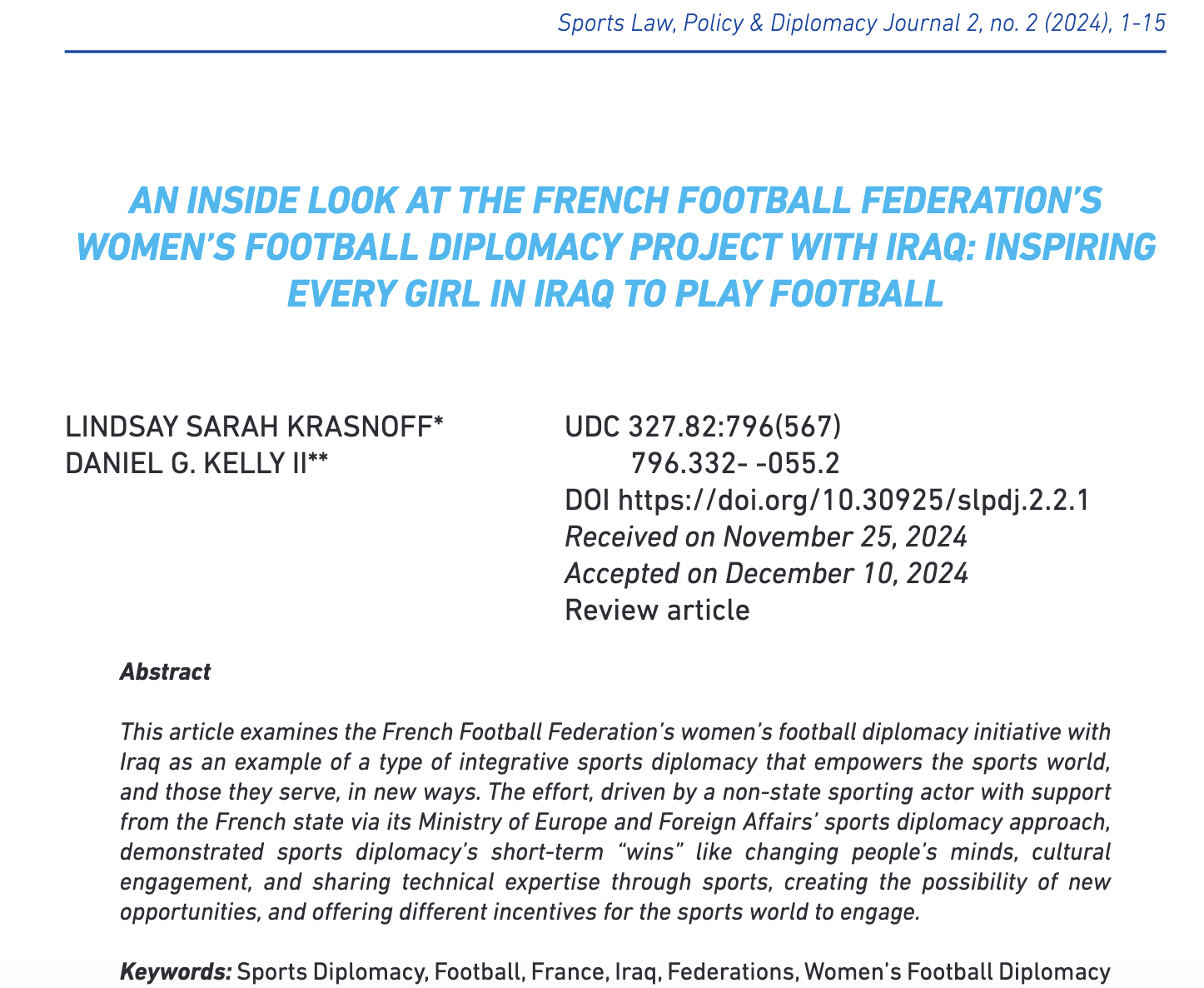
Greater details of the FFF’s program with Iraq are laid out in my 2024 article “An Inside Look at the French Football Federation’s Women’s Football Diplomacy Initiative with Iraq: Inspiring Every Girl in Iraq to Play Football” for Sports Law, Policy & Diplomacy (open access). A case study will soon be available for educators seeking to integrate the project and the questions it surfaces into the classroom.